
Guides
›
Cost Guide
·
Why Turf Smells
·
Heat & Cooling
·
Turf vs Sod
·
Pet vs Landscape Turf
·
Contractor Red Flags
Ball roll and break are decided before a single roll of turf is cut. Once the subsurface is set, nothing about how the green performs can be changed.
Most contractors who say they install putting greens are installing landscape turf on a landscape base and calling it a green.
It looks like a putting green. It does not putt like one.
Ball roll consistency, realistic break, and pace are determined by the subsurface - not the turf. Once the turf goes down, the contours are locked. There is no adjustment after the fact. Get the subsurface right or you have built an expensive flat patch of green.
Every green starts with a contour plan before any ground is broken. We design the break, the slope, and the collection areas on paper first. Which direction the ball will move. Where it will collect. How two cup positions will play differently from each other.
A flat green is a boring green regardless of how well it is built. We design for at least two distinct break directions and a minimum of two cup positions per installation.
Grade tolerance for a putting green: plus or minus one quarter inch. Landscape installs work at plus or minus one half inch. On a putting surface, that difference is felt every time a ball rolls across it.
Compaction: 95% Proctor density versus 90% for standard turf. The firmer foundation translates directly to ball response and durability under repeated putting strokes.
Drainage: a perimeter collection channel routes water off the playing surface. Puddles on a putting green are a base design failure, not a weather problem.
Putting green turf is nylon. Not polyethylene.
Nylon fibers maintain upright position under the weight of a golf ball and the pressure of repeated putts. They recover from foot traffic without permanent matting. Polyethylene does not.
Pile height: 3/8 to 1/2 inch. Face weight: 70 to 90 oz per square yard. These specifications produce the dense firm surface that creates consistent ball roll. A contractor proposing polyethylene on a putting surface is cutting a corner that will show itself the first time you chip onto the green.
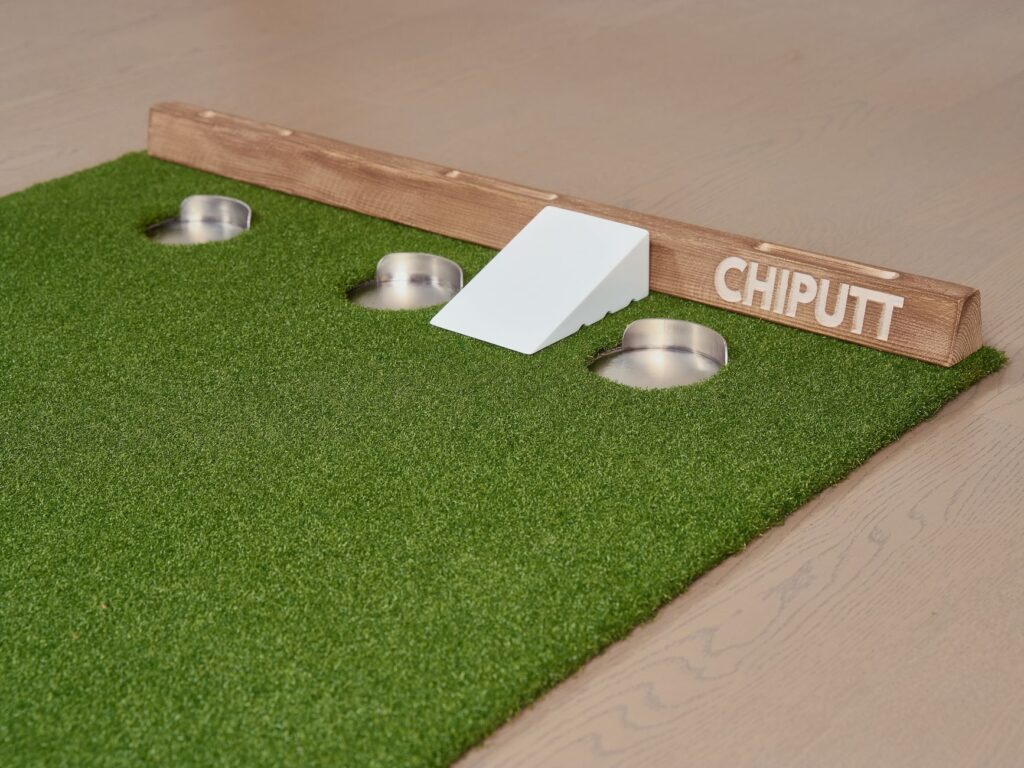
Regulation 4.25-inch cups are set into the base layer before turf installation - not cut through finished turf afterward. Cups added after the fact create raised edges that affect putts near the hole and disturb surrounding fibers permanently.
A properly designed green includes a fringe - a 12 to 18 inch band of slightly longer pile height surrounding the playing surface. The fringe manages chip shots, protects the short-pile surface from perimeter foot traffic, and creates a visible transition zone. Greens without fringe show accelerated edge wear within one to two seasons.
A correctly built residential putting green using proper materials will roll at approximately 8 to 10 on the Stimpmeter - comparable to a maintained municipal course. Premium installations using higher face weight nylon and tighter base grading can reach 10 to 12.
We give you an expected Stimp range for any product we propose. You should know what you are buying before the project starts.
Most residential LA putting greens range from 300 to 800 square feet. Under 200 square feet limits shot variety significantly. The 400 to 600 square foot range with two to three cups provides the best balance of challenge and spatial fit for typical LA backyards.
Putting green installation in Los Angeles runs $25 to $45 per square foot. A 400 sq ft green with fringe and two cups typically runs $14,000 to $20,000. See our cost guide for detailed variables.
Describe your project and we'll respond within one business day. No obligation.
Not sure what you need? Describe the problem and we'll tell you whether repair, replacement, or a new install makes the most financial sense.
We respond within one business day - real numbers, no sales call.