
Guides
›
Cost Guide
·
Why Turf Smells
·
Heat & Cooling
·
Turf vs Sod
·
Pet vs Landscape Turf
·
Contractor Red Flags
The two decisions made on installation day determine whether your pet area smells fine in three summers or becomes unusable. Most contractors get both wrong.
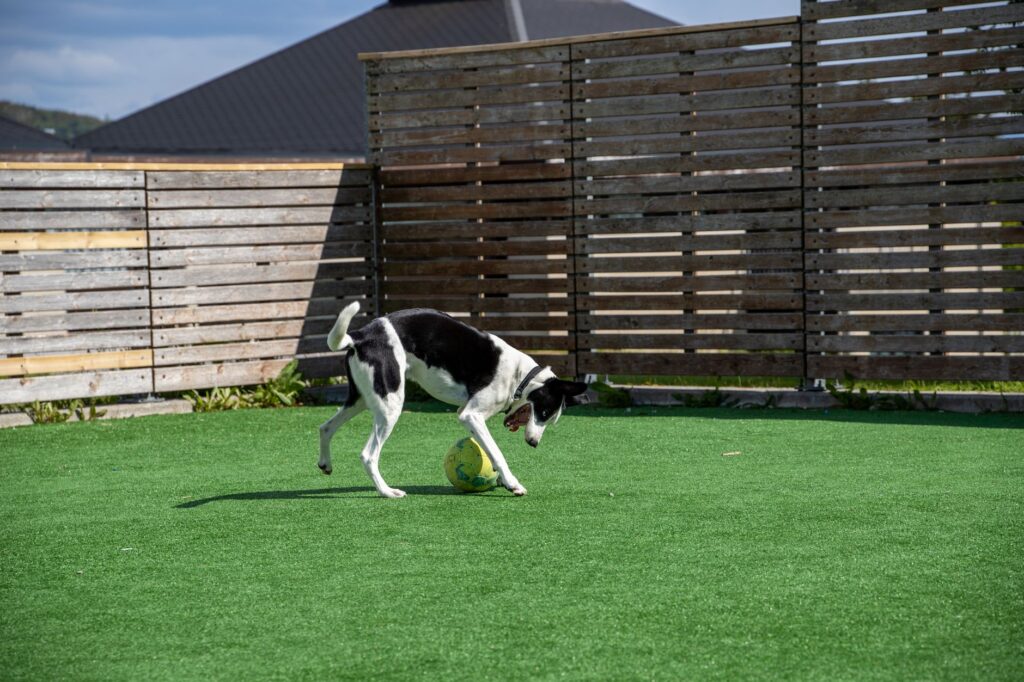
The call usually comes in August.
The yard was installed two summers ago. It smelled a little last year. This year it's unbearable. The installer told them to hose it down more.
Hosing it down more doesn't fix it.
The problem isn't maintenance. It's specification. Standard landscape turf installed in a pet environment was never designed for the load it's handling. The drainage can't keep up. The infill saturates. The smell is structural - and it gets worse every summer until the system is corrected.
Standard landscape turf backing drains at roughly 10 to 15 inches per hour. That's fine for rain and irrigation.
It's not adequate for daily dog waste at concentrated volume.
Pet turf backing specifies 30 to 50 inches per hour. Liquid passes through immediately without pooling at the surface. This is the most important specification in any pet installation - and the easiest number to verify. Ask any contractor for it before you sign anything. If they can't give you the number, they don't know the product they're selling you.
Silica sand absorbs ammonia. It has a finite capacity. Within one to three years of daily pet use, that capacity is exhausted. When LA temperatures climb, the trapped compounds off-gas.
ZeoFill neutralizes ammonia at the molecular level rather than absorbing it. It recharges its neutralizing capacity with fresh water. On a 95-degree LA summer day, the difference between a pet area that smells fine and one that clears the yard of humans is almost always the infill.
The cost difference is roughly $1.00 to $1.50 per square foot. The cost of extracting saturated sand and replacing it after the system has failed is $2 to $4 per square foot plus labor and disruption. Specify correctly the first time.
Pet areas require steeper minimum drainage slopes than standard turf - at least 1.5% to 2%. Flat yards require building grade into the base installation rather than relying on whatever slope the site naturally provides.
Most installers skip this step on flat lots. The result is liquid waste pooling at low points and odor concentrating where drainage fails first.
For dedicated dog runs and high-use areas with multiple dogs, a drainage mat below the base maintains a clear drainage channel as fine particles migrate downward over time.
For a single dog using a full-size yard, the drainage mat is often not required. We assess which situation applies during site evaluation and tell you what your specific use case requires - not what generates the highest invoice.
LA summer surface temperatures on dark turf in full sun reach 140 to 160 degrees Fahrenheit. Dog paw pad burns occur above 120 degrees. That threshold is crossed well before noon from June through September.
For pet areas, cooling infill is a safety specification - not an upgrade. Specify ZeoFill or HydroChill plus shade coverage for any area where dogs spend meaningful time. During peak summer hours from 11am to 4pm, keep dogs off exposed turf regardless of infill type.
Not every yard with a dog requires the complete system.
Full specification is right for dedicated dog runs, yards with multiple dogs, and areas with concentrated daily use in one zone.
Upgraded infill alone is often sufficient for a single dog using a full-size yard. The dilution effect across a larger area reduces backing permeability requirements significantly.
Standard landscape turf is appropriate when a dog has yard access but human use dominates and pet traffic is genuinely occasional.
We'll tell you which category your situation falls into. Specifying more than a project requires doesn't serve anyone.
Describe your project and we'll respond within one business day. No obligation.
Not sure what you need? Describe the problem and we'll tell you whether repair, replacement, or a new install makes the most financial sense.
We respond within one business day - real numbers, no sales call.